The Namataloa clan, a land-owning unit comprising about three hundred iTaukei (indigenous Fijians), steward approximately 238 hectares (589 acres) of diverse ecosystems including virgin forests, adjacent foreshore, a small island (Beqalevu), lagoon (Beqalevu Lagoon), and extensive reef systems (81 hectares; 200 acres). Since 2016, the clan has proactively dedicated 62 hectares (152 acres) of their land to conserve its rich biodiversity, which includes native plants, birds, and mammals endemic to the region. However, with no external support, the clan is facing the threat of the complete deforestation of this preserved site, called Lovowaqa, due to the encroachment of mainly illegal kava farming.
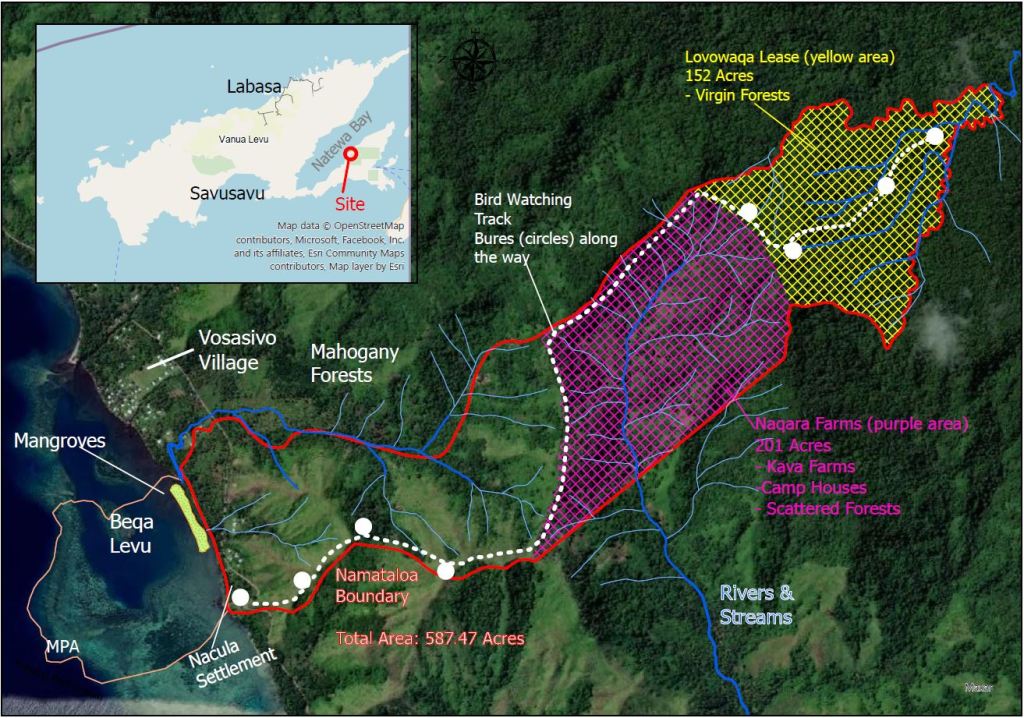
Fig.1
A Ridge-to-Reef Project and Eco-Tourism Plan
Fig. 1: The Namataloa land boundary, with the preserved forested area Lovowaqa and the proposed MPA in the Beqalevu Lagoon. The site is on the Natewa Tunuloa Peninsula, bordering Natewa Bay, Vanua Levu, the second largest island of the Fijian archipelago.
A Namataloa ridge-to-reef intervention, together with an eco-tourism objective, aim to create a model for successful ecosystem-based adaptation (EbA) that can be replicated in other regions.
 Fiji Bird Watch